Planning a home cinema? Discover the exact home theater setup cost in India for 2026. Explore prices from ₹50k to ₹1 Crore+, covering equipment, acoustics, and calibration.
How much does a Home Theater Setup Cost in India?
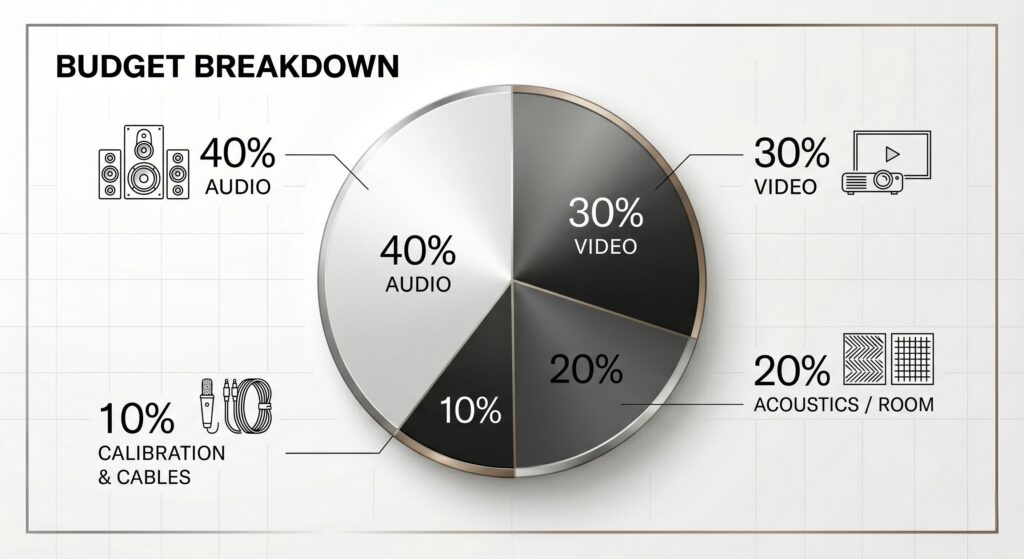
If you are planning to build a home cinema in 2026, the short answer is that a decent entry-level setup starts around ₹50,000, a high-quality Dolby Atmos living room system ranges from ₹2 Lakh to ₹5 Lakh, and a dedicated luxury home cinema can easily scale from ₹15 Lakh to over ₹1 Crore.
Home Theater Dolby Atmos setup Cost in India
Why is there such a massive gap? Building a home theater is not like buying a television; it is more like building a custom car. Two rooms might both have “surround sound,” but they will cost vastly different amounts depending on the scale of the room, the pedigree of the equipment, acoustic treatments, seating, automation, and—most importantly—professional calibration.
Whether you are an audiophile, an architect, or a movie lover upgrading your living room, this guide breaks down every rupee you will spend, ensuring you invest your budget where it actually matters.
1. What Determines Home Theater Cost in India?
A home theater is an ecosystem. The final cost of your project depends on several interconnected variables.
- Room Size and Type: A large, dedicated cinema room (e.g., 20×15 feet) requires significantly more powerful speakers, larger projection screens, and extensive acoustic paneling to fill the volume with impact. A 12×10 feet living room requires much less power.
- Living Room vs. Dedicated Room: Living rooms often utilize existing furniture and ambient light, leaning toward large OLED TVs and discreet speakers. A dedicated room requires complete light control, tiered seating, heavy acoustic treatment, and projectors, significantly increasing the structural and design costs.
- Display Technology (TV vs. Projector): An 85-inch Mini-LED or OLED TV costs between ₹2 Lakh to ₹4 Lakh. A true 4K laser projector paired with a 120-inch acoustically transparent screen will run between ₹5 Lakh and ₹15 Lakh.
- Speaker Count (The Configuration): A basic 5.1 system has six speakers. A modern Dolby Atmos 7.1.4 setup has 12 speakers. More speakers require a more expensive Audio/Video Receiver (AVR) to power and process them.
- AVR Quality: The brain of your system. Entry-level AVRs cost ₹50,000. High-end processors (like Trinnov or Anthem) cost ₹10 Lakh+ just for the processing unit.
- Room Acoustics: Sound bounces. Bare walls destroy audio quality. Acoustic panels (absorbers, diffusers, and bass traps) cost anywhere from ₹20,000 for basic foam to ₹5 Lakh for custom fabric-tracked architectural acoustic walls.
- Calibration: Equipment must be tuned to the room. Professional audio and video calibration using measurement microphones ensures the ₹5 Lakh system you bought actually sounds like a ₹5 Lakh system.
- Seating and Automation: Motorized recliner seats cost between ₹35,000 and ₹1,50,000 per seat. Smart home integration (Control4, Savant) for single-button “Movie Mode” adds ₹1 Lakh to ₹5 Lakh to the budget.
Before diving into specific component costs, use this interactive estimator to get a rough idea of how different choices impact your overall budget.
Home Theater Cost Estimator (2026)
Select your preferences below to calculate an instant estimated budget in Indian Rupees.
Estimated Total Cost
Cost Breakdown Summary
- Base Room Configuration: ₹0
- Display System: ₹80,000
- Audio System: ₹80,000
- Acoustics: ₹0
- Premium Seating: ₹1,20,000
- Calibration Services: ₹30,000
*This is a ballpark dynamic estimate based on current 2026 consumer electronics market rates in India including standard installation fees.
2. Home Theater Cost Breakdown by Budget
To make planning easier, we have categorized Indian home theater pricing into five distinct tiers based on 2026 market rates.
To make planning easier, we have categorized Indian home theater pricing into five distinct tiers based on 2026 market rates.
Budget Category Entry Level to Reference Cinema
Budget Category 1: Entry Level (₹50,000 – ₹1,50,000)
Best for: Small living rooms, apartments, and first-time buyers upgrading from TV speakers.
At this level, you are looking at premium soundbars or very basic entry-level 5.1 “Home Theater in a Box” (HTiB) systems. Modern soundbars have evolved significantly and often include wireless subwoofers and rear satellite speakers.
- Components: Flagship Soundbar with wireless rears OR basic entry-level AVR + 5.1 bookshelf speakers.
- Top Brands: Sony, Samsung, LG, JBL, Yamaha (HTiB).
- Performance Expectation: Huge upgrade over TV audio. Clear dialogue, decent bass, but lacks the true physical impact and spatial accuracy of larger systems.
Budget Category 2: Mid Range (₹1.5 Lakh – ₹5 Lakh)
Best for: Serious movie lovers wanting true surround sound in a living room or small media room.
This is where true custom home theater begins. You move away from soundbars and into dedicated Audio/Video Receivers (AVRs) powering passive, discrete speakers. This budget allows for a proper Dolby Atmos setup (like 5.1.2).
- Components: Mid-tier AVR, high-quality bookshelf or floor-standing front speakers, dedicated center channel, surround speakers, in-ceiling Atmos speakers, and a powerful 10-12 inch subwoofer.
- Top Brands: Denon, Marantz (AVRs); Polk Audio, Klipsch, Monitor Audio (Speakers); SVS (Subwoofers).
- Performance Expectation: Cinematic volume levels, chest-thumping bass, and true overhead 3D audio effects.
Budget Category 3: Premium (₹5 Lakh – ₹15 Lakh)
Best for: Dedicated media rooms or large, acoustically optimized living spaces.
At this tier, audio clarity and visual scale increase dramatically. Systems expand to 7.1.2 or 7.1.4 Atmos configurations. You also introduce entry-level 4K projection and basic acoustic room treatments.
- Components: High-end AVR with room correction (Dirac Live), premium floor-standing speakers, dual subwoofers for even bass distribution, 4K projector, fixed-frame screen, and basic acoustic panels.
- Top Brands: Denon, Marantz (AVRs); KEF, Bowers & Wilkins (B&W), Monitor Audio (Speakers); Epson, BenQ, Sony (Projectors); REL, SVS (Subwoofers).
- Performance Expectation: Reference-level volume (commercial cinema loudness without distortion). Flawless panning of sound around the room. Massive 100+ inch visual scale.
Budget Category 4: Luxury Home Cinema (₹15 Lakh – ₹50 Lakh)
Best for: High-net-worth individuals building custom, dedicated cinema rooms in villas or farmhouses.
This budget buys a completely engineered space. The room itself is designed for sound isolation. Equipment is hidden behind acoustically transparent fabric walls. Lighting, climate, and media are controlled by a single automation system.
- Components: Separate AV Processor and multi-channel Power Amplifiers, true 4K Laser Projection, Acoustically Transparent screen, custom acoustic architecture, motorized cinema recliners, and advanced automation.
- Top Brands: Anthem, Marantz Separates; Focal, Martin Logan, KEF, B&W (Speakers); JVC, Sony (Projectors); Control4, Lutron (Automation).
- Performance Expectation: Outperforms standard commercial cinemas. Pitch-black contrast, pixel-perfect HDR, and audio that pressurizes the room without ear fatigue.
Budget Category 5: Reference Cinema (₹50 Lakh – ₹1 Crore+)
Best for: The ultimate, uncompromised cinematic experience.
These systems represent the absolute pinnacle of audio-video engineering. They are designed using acoustic physics, featuring baffle walls, intense soundproofing, and equipment used in Hollywood mastering studios.
- Components: 16 to 32 channel digital audio processors, active speakers with dedicated amplification per driver, MadVR video processing, massive multi-subwoofer arrays.
- Top Brands: Trinnov Audio, StormAudio (Processors); Wisdom Audio, JBL Synthesis, Procella Audio, Meyer Sound (Speakers); Barco, Christie, High-End JVC (Projectors); MadVR (Video Processing).
- Performance Expectation: Absolute sonic and visual perfection. Every seat is the “sweet spot.” Perfect bass uniformity and microscopic audio detail.
3. Cost of Every Major Component
Let’s break down the individual costs of the gear required to build a dedicated home cinema in India.
Audio/Video Receivers (AVRs) & Processors
The AVR decodes the audio formats (like Dolby Atmos) and amplifies the speakers.
| Brand & Tier | Channels | Estimated Price (INR) |
| Denon / Yamaha (Entry) | 5.2 to 7.2 | ₹45,000 – ₹80,000 |
| Denon / Marantz (Mid) | 7.2 to 9.2 | ₹90,000 – ₹1,80,000 |
| Anthem / Marantz (High) | 11.2 to 15.4 | ₹2,50,000 – ₹5,00,000 |
| Trinnov / Storm (Luxury) | 16 to 32+ (Processors) | ₹15,00,000 – ₹35,00,000+ |
Home Theater Speakers
Pricing below is for an entire 5.1 or 7.1 base layer speaker package (excluding subwoofers).
| Brand / Series | Category | Estimated Price (INR) |
| Polk Signature / Klipsch Reference | Entry-Mid | ₹1,00,000 – ₹2,00,000 |
| Monitor Audio Bronze / KEF Q Series | Mid-High | ₹2,00,000 – ₹4,00,000 |
| Bowers & Wilkins 700 / Focal Aria | Premium | ₹5,00,000 – ₹10,00,000 |
| JBL Synthesis / Wisdom Audio | Reference | ₹20,00,000 – ₹80,00,000+ |
Subwoofers
The subwoofer provides the Low-Frequency Effects (LFE). Never skimp here. Dual subwoofers are highly recommended for even bass.
| Brand & Model | Driver Size | Estimated Price (INR) |
| Polk HTS / Klipsch R-Series | 10″ – 12″ | ₹35,000 – ₹60,000 |
| SVS PB-1000 Pro / REL HT/1205 | 12″ | ₹80,000 – ₹1,20,000 |
| SVS PB-3000 / REL Predator | 13″ – 15″ | ₹1,80,000 – ₹2,50,000 |
| JTR / Paradigm Persona / JL Audio | 15″ – 18″+ | ₹4,00,000 – ₹10,00,000+ |
Projectors and Screens
Projectors require a pitch-black room for optimal performance.
| Component | Entry / Mid | Premium / Luxury |
| Projector | BenQ / Epson (₹1L – ₹3L) | Sony / JVC Laser (₹6L – ₹25L+) |
| Projection Screen | Elite Screens / Lumina (₹40k – ₹1L) | Stewart / Screen Innovations (₹2.5L – ₹6L) |
Supporting Infrastructure
- Acoustic Panels: ₹30,000 (basic living room kit) to ₹5,00,000+ (full room fabric tracking).
- Cinema Seating: ₹35,000 to ₹1,50,000 per seat (brands like Recliner House, Moovia, FrontRow).
- Smart Automation: ₹1,00,000 to ₹5,00,000+ (Control4, Savant, lighting control).
- Cables & Power Conditioning: ₹20,000 to ₹1,50,000+ (high-speed fiber optic HDMI, 12 AWG speaker wire, power stabilizers).
4. Home Theater Brand Comparison
With hundreds of brands in India, choosing the right one can be overwhelming. Here is a comparison of the most popular speaker brands.
| Brand | Sound Signature | Movie Performance | Music Performance | Suitable Room Size | Value for Money | Budget Range |
| Polk Audio | Warm, forgiving | Excellent | Good | Small to Medium | Very High | Entry to Mid |
| Klipsch | Dynamic, bright, loud | Incredible (High impact) | Average (Can be harsh) | Medium to Large | High | Mid to Premium |
| Monitor Audio | Neutral, detailed | Excellent | Excellent | Small to Large | High | Mid to Premium |
| KEF | Highly precise, wide stage | Excellent | Phenomenal | Small to Medium | Moderate | Premium to Luxury |
| B&W | Refined, revealing | Very Good | Flawless | Medium to Large | Moderate | Premium to Luxury |
| Focal | Fast, analytical, punchy | Excellent | Excellent | Medium to Large | Moderate | Premium to Luxury |
Pro Tip: Klipsch speakers utilize “horn-loaded” tweeters, making them incredibly efficient and loud, which is why they excel for action movies. KEF uses a “Uni-Q” driver where the tweeter sits inside the mid-range cone, creating a massive “sweet spot,” making them perfect for multi-purpose rooms where music is a priority.
5. Why Calibration Matters More Than Expensive Equipment
If there is one concept you take away from this guide, let it be this: A ₹5 Lakh system that is professionally calibrated will completely destroy a ₹10 Lakh system that is uncalibrated.
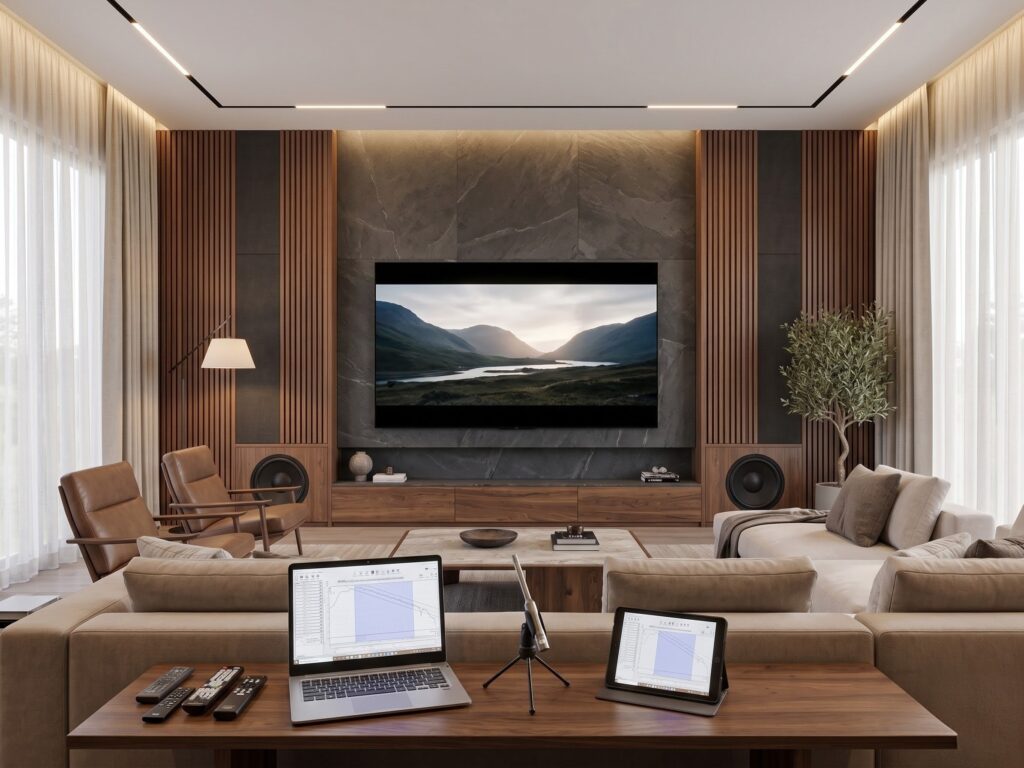
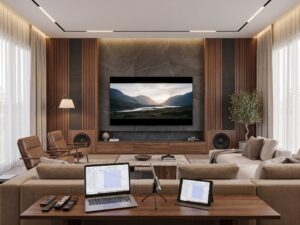
In this setup, we place a highly sensitive UMIK-1 measurement microphone precisely at the main listening position (ear-level on your recliner!). Using advanced cinema tools like REW (Room EQ Wizard), Dirac Live, and Audyssey MultEQ, we measure exactly how the sound waves from your massive tower speakers interact with your walls and acoustic paneling.
Whether we are tuning a heavy setup with Sonus Faber and JBL speakers, or configuring a powerful Denon or Marantz AVR, we adjust the frequencies to eliminate harshness and deliver a flat, reference-grade audio response. The result? Crisp dialogue, deep punchy bass, and a perfectly balanced 3D soundstage.
What is Home Theater Calibration?
When you place a speaker in a room, the sound coming out of it interacts with the walls, floor, ceiling, and furniture before it reaches your ears. The room acts as a giant acoustic equalizer. A perfectly flat speaker will sound muddy and distorted in an untreated, uncalibrated room because certain frequencies will cancel each other out, while others will amplify and “boom.”
Calibration is the scientific process of using measurement microphones (like the UMIK-1) and software (like REW, Dirac Live, or Audyssey) to measure how the room alters the sound, and then applying digital correction to fix those errors.
What Does Calibration Actually Do?
- Speaker Level Calibration: Ensures every speaker plays at the exact same volume (usually 75dB) at the main listening position, so the surround effects aren’t drowned out by the front speakers.
- Distance and Time Alignment: Sound travels at ~343 meters per second. If your center speaker is 10 feet away, and your surround is 5 feet away, the surround sound hits your ear first. Calibration delays the closer speakers in milliseconds so all audio arrives at your ear at the exact same instant, creating a holographic 3D bubble.
- Phase Alignment & Subwoofer Integration: The hardest part of audio. Getting the subwoofer (bass) and the main speakers to hand off frequencies smoothly at the “crossover point” (usually 80Hz). If they are out of phase, the bass waves will cancel each other out, leaving you with weak, hollow sound regardless of how big your subwoofer is.
- EQ and Room Correction: Taming the massive spikes and dips in bass response caused by room dimensions (known as room modes).
6. Stages of Professional Home Theater Calibration
Professional calibration is an engineering service, not just “pressing a button on the remote.” Here are the stages a professional calibrator in India will go through:
Stage 1: Room Analysis
Calculating the room’s dimensions to identify mathematical “room modes” (frequencies where bass will inevitably boom or disappear based on physics).
Stage 2: Speaker Placement
Using Dolby guidelines to place speakers at precise angles relative to the main listening position (e.g., front speakers at 22-30 degrees, Atmos overheads at 45 degrees elevation).
Stage 3: Subwoofer Placement (The Sub Crawl)
A subwoofer cannot be placed “wherever it looks nice.” The calibrator places the sub in the main seat, plays a test tone, and crawls around the floor to find the spot where the bass sounds tightest, then places the subwoofer there.
Stage 4: Acoustic Evaluation
Identifying first reflection points on the side walls using a mirror to place acoustic absorption panels, preventing slap-echo.
Stage 5: Measurement Microphone Testing
Connecting a calibrated UMIK-1 microphone to a laptop running Room EQ Wizard (REW) to take raw sweeps of the room’s frequency response from 10Hz to 20,000Hz.
Stage 6: AVR Configuration
Setting manual speaker sizes (Small vs. Large), crossover frequencies, and checking wiring polarity.
Stage 7: Automated Room Correction
Running high-end software like Dirac Live, ARC Genesis, or Audyssey MultEQ XT32 to generate correction filters that are uploaded into the AVR to flatten the audio response.
Stage 8: Manual Fine Tuning
Automated software often gets subwoofer distance and crossover wrong. The professional manually adjusts the delays to ensure perfect phase alignment across all speakers.
Stage 9: Verification Measurements
Running a final sweep in REW to ensure the target curve has been achieved and no nulls exist in the crucial vocal ranges.
Stage 10: Reference Listening
Playing familiar cinematic clips (like the race from Ready Player One or the bombing in Unbroken) to ensure the bass is tactile but not bloated, and dialogue remains crystal clear amidst chaos.
7. Common Mistakes People Make
Avoid these expensive pitfalls when building your Indian home cinema:
- Buying Expensive Speakers but a Cheap AVR: A ₹3 Lakh pair of B&W speakers driven by a ₹40,000 entry-level AVR will sound anemic. The amplifier will lack the current to drive the dynamics.
- Ignoring Acoustics: Buying premium gear and putting it in a room with marble floors, glass windows, and bare walls. The audio will echo horribly, ruining dialogue intelligibility.
- Wrong Center Channel Placement: Shoving the center speaker deep inside a wooden TV cabinet. This creates a “boxy” sound. It must be pulled to the edge.
- No Calibration: Using the factory default settings. You are only getting 40% of what your system is capable of.
- Tiny Subwoofer in a Large Room: Subwoofers pressurize the volume of the room. A small 8-inch sub in an open-concept living/dining area will literally do nothing.
- Using Showroom Demos as a Reference: Showrooms are acoustically treated to make gear sound perfect. That gear will sound entirely different in your untreated living room.
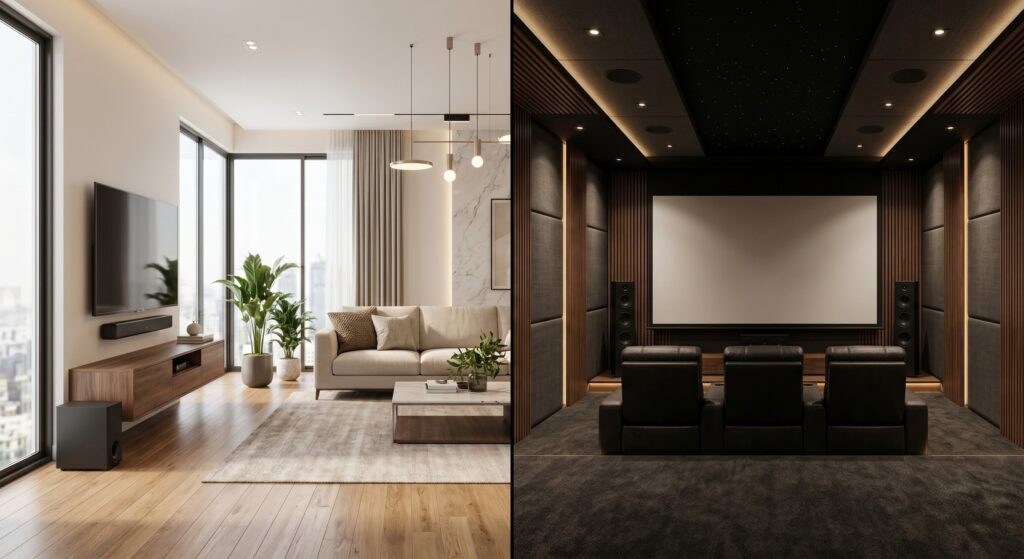
8. Living Room Home Theater vs Dedicated Home Cinema
Deciding between adapting your living space or building a dedicated room?
| Feature | Living Room Home Theater | Dedicated Home Cinema |
| Typical Cost | ₹1.5 Lakh – ₹5 Lakh | ₹10 Lakh – ₹1 Crore+ |
| Acoustics | Hard to treat; compromises made for aesthetics. | Fully treated walls, bass traps, isolation. |
| Display | Large OLED/Mini-LED TV (High ambient light). | 4K Projector & Acoustically Transparent Screen. |
| Seating | Sofas and sectionals. | Tiered, motorized cinema recliners. |
| Performance | Great for casual viewing and family time. | Uncompromised reference audio and video. |
| Flexibility | High (Used for TV, gaming, socializing). | Low (Purpose-built for movies/critical listening). |
9. Frequently Asked Questions (FAQs)
1. How much does a basic 5.1 home theater cost in India? A quality component-based 5.1 system starts around ₹1,00,000 to ₹1,50,000 (AVR + Speakers + Subwoofer).
2. How much does a Dolby Atmos Home Theater cost in India? A true 5.1.2 Dolby Atmos setup with overhead speakers will cost a minimum of ₹1,80,000 to do correctly with entry-mid tier brands.
3. What is the ideal budget for a good home cinema? For a dedicated room that provides a massive upgrade over a commercial cinema, ₹15 Lakh to ₹20 Lakh is the sweet spot for premium gear and basic room treatment.
4. Should I buy a soundbar or a component system? Buy a soundbar if space, budget (under ₹80k), or aesthetics (no wires) are your primary concerns. Buy an AVR/component system if longevity, upgradeability, and actual cinematic impact are your goals.
5. Do I need acoustic treatment? Yes. Even basic thick rugs, heavy curtains, and canvas paintings help. For a dedicated room, proper acoustic panels are mandatory for clear sound.
6. How often should calibration be done? Once, when the system is installed. You only need to recalibrate if you change a component (like a new AVR or subwoofer), move the furniture, or add/remove acoustic treatments.
7. Can calibration improve bass? Absolutely. It is the only way to remove the “boomy” or muddy bass caused by room modes, revealing tight, chest-thumping low frequencies.
8. Which is better: Denon or Marantz? They are owned by the same parent company. Denon is typically tuned for dynamic movie watching, while Marantz features a slightly warmer tuning preferred for music.
9. Are projectors better than TVs? TVs offer better contrast and brightness for the price. Projectors offer massive scale (100-150 inches) that TVs cannot match economically, but require pitch-black rooms.
10. What is an acoustically transparent screen? A projector screen made of woven fabric that allows sound to pass through. This lets you hide your speakers directly behind the screen, just like in a real movie theater.
11. Why are two subwoofers recommended? Two subwoofers aren’t necessarily for “more” bass; they are for “smoother” bass. Multiple subwoofers cancel out room nulls, ensuring every seat in the room gets good bass.
12. How much does a home theater projector cost in India? A good entry-level 4K-pixel-shifting projector (like BenQ) costs ₹1.5 Lakh. Native 4K laser projectors (like Sony or JVC) start around ₹6 Lakh.
13. What is the difference between 5.1, 7.1, and 7.1.4? The first number is ear-level speakers (front, center, surrounds). The second is the subwoofer count. The third is overhead Atmos speakers. 7.1.4 means 7 ear-level, 1 sub, 4 ceiling speakers.
14. Are wireless home theater speakers good? They require power cables, so they aren’t truly wireless. Wired passive speakers driven by an AVR will always offer superior performance and reliability for the same price.
15. How much space do I need for a dedicated home cinema? A minimum of 12×15 feet is recommended, but 15×20 feet allows for two rows of seating and optimal speaker breathing room.
16. What is Dirac Live? Dirac Live is one of the world’s most advanced digital room correction software platforms, included on high-end AVRs to mathematically fix acoustic issues in your room.
17. Do I need power conditioning? In India, absolutely. Voltage fluctuations can fry expensive AVRs and projectors. A high-quality voltage stabilizer and surge protector is mandatory.
18. Why do home theater recliners cost so much? They are built with specific lumbar support for 3-hour viewing, utilize whisper-quiet motors, and often include tactile transducers (bass shakers) bolted to the frame.
19. How long does a home theater installation take? A living room setup takes 1-2 days. A custom dedicated room with acoustics, wiring, and finishing can take 3 to 6 weeks.
20. Can I mix and match speaker brands? You can mix the subwoofer with any brand. However, your Front Left, Center, and Front Right speakers MUST be from the same brand and product line to ensure a seamless “timber match” when voices pan across the screen.
Conclusion
Building a home theater in India is a journey that goes far beyond buying expensive boxes from a showroom. A ₹10 Lakh budget thrown at random high-end gear will almost always sound inferior to a carefully planned ₹4 Lakh system placed in an acoustically treated room and tuned by a professional.
Equipment selection alone does not guarantee performance. The room design, acoustic architecture, precise installation, and exhaustive audio calibration are equally—if not more—important than the logos on the speakers.
This is where expertise makes the difference. Orwins specializes in home theater design, home cinema installation, acoustic planning, equipment selection, and professional calibration services across India. By focusing on the science of sound and video, Orwins helps customers achieve superior, reference-level performance from their investment, ensuring your home cinema delivers the magic of the movies exactly as the director intended.